Showing posts with label culture. Show all posts

24 July 2013

phoning in classist humor


Mashable shared this ExtraLife comix strip last week and asked: "Which side do you fall on?"


The joke bombed for me, and not because I'm an Android user. I found it classist. The strip presents two stereotypes: The iOS user -- appearing white, male, and in his early 20s -- is well-adjusted, smartly groomed, and willing to spend money. The Android user -- also appearing white and male, but older -- is surly, sloppy, and cheap. The punchline hinges on their physical and spending differences. At the Android user's expense. The stereotype supposes bad character, not a lack of economic options. Apple's gadgets via iOS are a premium (i.e. more expensive) brand; Android's open source lends itself to generic (i.e. less expensive) brands. So, yeah, the joke flopped for me, especially since I've recently been introduced to the comedy-rule concept of "don't hit down" -- it's not good form for jokers in privileged social positions to "hit" those below them on the social ladder. The ExtraLife strip smacked of socioeconomic "hitting down" to me.

So what's the truth? Who are iOS users and who are Android users? Do they fit the strip's caricatures? A brief Google search turned up this article highlighting a Pew/American Life June 2013 report on iPhone and Android phone-user demographics. Princeton Survey Research Associates International conducted a phone survey of 2,252 adults (a solid sample size for generalization) and found...

OWNERSHIP: 25% own an iPhone. 28% own an Android phone.
RACE: A relative majority of iPhone owners identify as White. A relative majority of Android owners identify as Black.
GENDER: More women than men own iPhones. More men than women own Androids.
AGE: A plurality of iPhone users are 25-34 years-old. A plurality of Android users are 18-24.
INCOME: 36% of iPhone-user households make less than $50K/year; 40% make more than $75K. 55% of Android-user households make less than $50K; 31% make more than $75K.

If the ExtraLife strip was redrawn to present more generally accurate portraits, then... panel one (iOS) would feature a 30-year-old middle-class white woman and panel two (Android) would feature a 20-year-old lower-middle-class black man. Gadget OSs reflect social class differences on multiple levels. That's not funny. That's thought provoking.

18 May 2011

robot marx, the book


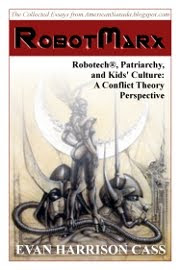
Robot Marx - Robotech®, Patriarchy, and Kids' Culture: A Conflict Theory Perspective is now available as a book. I'll be premiering it this weekend at Saint Paul, Minnesota's SpringCon.

Robot Marx -- "The Collected Essays from AmericanNarada.blogspot.com" -- is a 5-inches wide x 7.5-inches tall, square-bound, full-color, 38-page paperback. Sold at-cost, this "Not-for-profit Academic Scholarship intended for Education" publication is available for $5.00 U.S. From the back cover:

When ROBOTECH -- the classic 85-episode "sci-fi soap opera" cartoon that introduced a generation of American kids to Japanese animation -- premiered in 1985, it stood out from its contemporaries. Unlike iconically similar G.I. JOE and TRANSFORMERS, ROBOTECH's characters lived and died, met and fell in love, and expressed real emotions and evolved as individuals. The program spawned toys, comix, role-playing games, novels, and other pop-cultural artifacts. From the Conflict-Marxist assumption that America is a patriarchal society, ROBOTECH is a fascinating case study: it featured women heroes in leadership positions, a cross-dressing male hero, and an essentially anti-war message, among other subversive elements. ROBOT MARX critiques ROBOTECH, its marketing, and its fandom from this perspective, in the process discussing concepts such as gender representation, diva citizenship, and archetypes. An enjoyable academic expression of fandom.

The book was born from a number of influences. First, last month's "remastered" ROBOT MARX project* re-sparked my latent ROBOTECH fandom. From 2001 to 2004, I edited and published the "official" unofficial ROBOTECH fanzine, Emissaries; Robot Marx was an excuse to indulge in that fandom while being able to provide something new for my fellow fans again. Second, I was inspired after reading Stephen Bissette's Teen Angels & New Mutants to do something similar; I wanted to do for ROBOTECH what he did for Rick Veitch's BRAT PACK. In an admittedly limited way, Robot Marx fit the bill. And third, pulling the book together allowed me to flex my publishing muscles (I have an Associate's degree in Printing & Publishing) in preparation for the forthcoming American Narada: India 1 reflections and comix collection. Using nothing but freeware, Robot Marx was a fun DIY exercise.


Midwest Comic Book Association's SpringCon "Comic Book Celebration" is held at the Minnesota State Fairgrounds' Grandstand from 10 AM to 5 PM on both Saturday and Sunday (May 21 & 22); with a canned-food donation, admission is only $10 for the weekend. I'll be tabling alongside friend and uber talented tattoo-artist/cartoonist/designer, Jennifer "Inkbunny Diaries" Young. If you're in the region, I encourage you to attend. MCBA puts on a great show. I'd love to meet AMERICAN NARADA's readers and my fellow ROBOTECH and comix fans, so, please -- if you do attend -- stop by my table and say "Hi!"

Robot Marx will be available for purchase there. The book is also available online via IndyPlanet.

- - -

* ROBOTECH ® and all associated concepts, names, designs, and images are trademark and copyright Harmony Gold USA, Inc. 1985-2011. Application of such for the ROBOT MARX project by Evan Harrison Cass is based on the U.S. Copyright principle of Fair Use for not-for-profit "criticism, comment, news reporting, teaching, scholarship, and research." No infringement of Harmony Gold USA, Inc.'s or associated companies' and individuals' rights is intended.

30 April 2011

sheila, play with robots


To close out the month-long ROBOT MARX project, here are a couple peripheral asides...

Aside 1: In addition to the semester-long WOM 203 writing project that ultimately became ROBOT MARX were a number of other written assignments. Following a week of readings and discussions about popular music, my classmates and I were assigned to pick a song, critique it from the Conflict-Marxist patriarchal-society perspective, and write a one-page analysis. I chose a song from my favorite band -- The Smiths' "Sheila Take A Bow." I had a ball writing it; here's the essay...


British pop-music singer/songwriter, Steven Patrick Morrissey said: "The sexes have been too easily defined. People are so rigidly locked into these two little categories. ... It limits people's potential in so many areas. I think we should slap down these barriers" (qtd. in Robertson 8, 9). Throughout his 26 year career -- starting in 1984 as lyricist for and lead-singer of The Smiths -- Morrissey has actively tried to subvert the patriarchal social structure. For example, 1987's "Sheila Take A Bow" playfully challenges patriarchy on all four of Allen Johnson's defined fronts (5-15).

"Patriarchy is male dominated in that positions of authority [in the world] ... are generally reserved for men" (Johnson 5). Morrissey writes and sings: "Sheila ... / Boot the grime of this world in the crotch, dear" (lines 5, 6). The word "crotch" is most often associated with male genitals, therefore Morrissey is encouraging the song's female protagonist to challenge and rebel against patriarchal society's ascribed expectations for her.

"Patriarchal societies are male identified in that the core cultural ideas about what is considered ... normal are associated with how we think about men and masculinity" (Johnson 6). Society's concept of the differences between "male" and "female" genders are established and reinforced by patriarchy; in the song, Morrissey -- a "male" singer/songwriter -- is singing about Sheila -- a "female." Within this context, Morrissey writes and sings: "Take my hand and off we stride / You're a girl and I'm a boy" (lines 17, 18). In the very next verse, though, Morrissey matter-of-factly takes the opportunity to subvert and confuse gender norms: "Take my hand and off we stride / I'm a girl and you're a boy" (lines 19, 20).

"[Patriarchy] is male-centered, which means that the focus of attention is primarily on men and what they do. ... Male experience is what patriarchal culture uses to represent human experience, even when it is women who most often live it" (Johnson 10). The fact that Morrissey is writing and singing about a woman and her life differentiates him from the majority of his fellow male singer/songwriters who typically sing and write about themselves or the "girls they love." This is reinforced by two of the song's lines: "Is it wrong to want to live on your [Sheila's] own? / ... Throw your homework [patriarchy's gender conditioning] into the fire" (lines 1, 22).

"[Patriarchy] is an obsession with control as a core value around which social life is organized. ... As a result, controllers come to see themselves as subjects who intend and decide what will happen, and to see others as objects to act upon" (Johnson 14, 15). In patriarchal societies, men are the controllers -- the "choosers" -- and women are the controlled -- the "chosen." Here, again, Morrissey subverts the structured norm: "[Sheila] come out and find the one that you love and who loves you" (line 8). Morrissey admonishes the female protagonist to choose for herself a lover, and admonishes her to choose someone who loves "you" -- i.e. Sheila, "the full and complex human being" (Johnson 15). It is also interesting to note that Morrissey leaves the gender of the to-be-chosen lover ambiguous: s/he could be "male," "female," or other.

As exemplified by The Smiths' "Sheila Take A Bow," Morrissey has actively challenged and questioned patriarchy throughout his career. In choosing to consume similarly subversive media, all of us -- "male" and "female" alike -- can do our part in "[challenging patriarchy's] status quo" (Johnson 19).

- - -

Johnson, Allen G. The Gender Knot: Unraveling Our Patriarchal Legacy. Rev. ed. Temple UP, 2005. Print.

Morrissey/Marr Songs Ltd. "Sheila Take A Bow." 1987. Musical composition. Performed by The Smiths, from the compact disc Louder Than Bombs (Sire, 1987).

Robertson, John. Morrissey: In His Own Words. London: Omnibus, 1988. Print.

Aside 2: Behold...


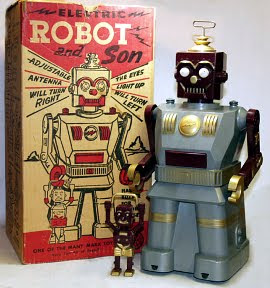
... the original Robot Marx (and son)! A Blogger Stats' traffic-source pointed me to this classic toy manufactured by Louis Marx & Company. From the website, Vintage Robot Toys:

Of the many toys it produced, Marx's line of toy robots are undoubtedly among the most beloved by collectors. Marx introduced this line in the 1950s and 1960s to capitalize on the space and robot craze of the era... These toys included ... Robot and Son, which was released in 1956 and was the first robot toy Marx produced... Founded in 1919, Marx toys were a fixture in five and dime stores as well as with retailers such as Montgomery Ward and Sears, which sold their wares through mail order catalogs. ... The company philosophy of giving their customers 'more toy for less money' helped make Louis Marx one of the most successful toy makers in America; at the height of the Great Depression of the 1930s, when many companies were floundering, Marx not only recorded growing revenues, it was also able to open three factories. By the 1950s, Marx had become the largest toy manufacturer in the world, and founder Louis Marx was crowned "the Toy King" by no less than Time magazine in 1955. ... Louis Marx eventually closed its doors in 1978.

Neat, huh? Now I want one to stand alongside my ROBOTECH Raider X. Too bad it'd cost me over $200... Maybe I'll just write a paper about it instead.

And with that -- ROBOT MARX is officially a wrap.

24 April 2011

robot marx, part 6


Robotech®, Patriarchy, and Kids' Culture:
A Conflict Theory Perspective


In her essay "Producing Girls: Rethinking the Study of Female Youth Culture," Mary Celeste Kearney examines the role female teens and young women have played and continue to play in consuming, shaping and creating media. From solicited contributions in corporate, commercial magazines to anti-corporate, do-it-yourself (DIY) zines, Kearney tracks the history of the compromises and conflicts between "for girls" and "by girls" in the context of "producing girls," i.e. girls as "cultural producers" (286). Similarly throughout its history, "corporate" ROBOTECH has coexisted and occasionally come into conflict with "DIY" ROBOTECH; and, through it all, "producing girls" have been active participants.


An example of solicited contributions in a corporate, commercial publication is that of ROBOTECH: ART 2. ART 2 was the second in a series of three ROBOTECH art books released in the 1980s by boutique publisher Starblaze/The Donning Company. Whereas ART 1 was a "series bible" of sorts (episode guide, character profiles, behind-the-scenes production notes), ART 2 was a high-end collection of professional and amateur artworks. Of the 19 artists featured, six (32%) were women; notably, of the 78 artworks included, 49 (63%) were created by female artists. ART 2 is considered by many ROBOTECH fans as one of the series' finest merchandise items ever released -- an item that would not have existed were it not for the female artists (professional and amateur alike) who contributed to its contents.

The late 1980s into and throughout the 1990s saw, at first, a renaissance in "old school" fanzines (Kearney 299) focused on ROBOTECH, followed by -- as the internet entered the mainstream -- an explosion in ROBOTECH-specific fan websites (fansites). This was an era that found ROBOTECH's corporate owners, Harmony Gold, legally passive in regards to their ROBOTECH brand; fans were able to create -- unchecked -- DIY fan-fictions, fan-artworks and fan-communities. In the case of both fanzine and fansite contributions, many female fans generously contributed their writings and artworks. An interesting note regarding female ROBOTECH fans: They seemed to be primarily responsible for website "shrines" that focused on specific series' characters and couples (two sites that The Author recalls dealt with "The Masters"' character Musica and the "New Generation" couple Scott and Marlene). Kearney explains why this might be: "[Much] of this (sub)cultural activity on the part of today's youth is not entirely independent from the mainstream media and popular culture upon which it must rely not only for publicity and promotion, but also for source material..." (298).


The year 2000 saw Harmony Gold actively reasserting control over its ROBOTECH brand. Through to the present, Harmony Gold's legal department has occasionally targeted fanzines and fansites with a "cease and desist" letter; the result, sadly, is that many of the fan produced relics of the previous decades -- many by "producing girls" -- have been abandoned or altogether lost. Harmony Gold has tried to make amends by establishing a "Fan Art & Fiction" section on their official ROBOTECH website for the program's fans, but (in The Author's opinion) the creative works lack a certain genuineness and integrity inherent in Harmony Gold's defaulted legal submission filter.

Despite these recent challenges, the heritage of ROBOTECH's fandom is positively felt to this very day -- especially in regards to female fans moving beyond being "producing fangirls" to become independent "cultural producers." As Kearney says: "In numbers now too big to ignore, female adolescents are increasingly involved in the production of films and videos, the recording of music, the publication of literature, and the manufacturing of clothing and fashion accessories" (289).

- - -

BIBLIOGRAPHY


Kearney, Mary Celeste. "Producing Girls: Rethinking the Study of Female Youth Culture." Unknown. N.p.: n.p., n.d. 285-309. Print.

"Lonely Soldier Boy." ColleenDoran.com. Colleen Doran, 2011. Web. 2010. http://colleendoran.com/2010/04/01/04012010/.

Reynolds, Kay, ed. Robotech: Art 2. Norfolk, Virginia: Donning Company/Publishers, 1987. Print.

Robotech.com. Harmony Gold USA, Inc., 2007. Web. 2010. http://robotech.com/.

- - -

ROBOTECH ® and all associated concepts, names, designs, and images are trademark and copyright Harmony Gold USA, Inc. 1985-2011. Application of such for the ROBOT MARX project by Evan Harrison Cass is based on the U.S. Copyright principle of Fair Use for not-for-profit "criticism, comment, news reporting, teaching, scholarship, and research." No infringement of Harmony Gold USA, Inc.'s or associated companies' and individuals' rights is intended.

20 April 2011

robot marx, part 5


Robotech®, Patriarchy, and Kids' Culture:
A Conflict Theory Perspective


Like other "boy" cartoons of the 1980s, ROBOTECH had an action-figure line of toys. But unlike its contemporaries' lines (ex. He-Man & the Masters of the Universe and G.I. Joe: A Real American Hero), ROBOTECH's was unique in that it featured a notable number of female characters. Whereas He-man had She-Ra and G.I. Joe had Scarlett -- "token" female characters -- ROBOTECH had significant, "essential" female characters.


The ROBOTECH action figures released in 1985 by Matchbox were modeled after the hugely successful G.I. Joe figures of the time -- mostly 3 3/4 inches tall; packaged on "character cards" that included a character biography and a listing of other figures in the line; accessorized with a gun and helmet, and/or some other character-specific item(s); and engineered so as to be placed within higher-priced line-specific vehicles as "pilots." Although Matchbox's ROBOTECH vehicles were highly regarded for their quality and playability, the same cannot be said about their ROBOTECH action figures, which were low in quality and lacked playable poseability (i.e. they had limited toy-joint articulation). Due to this, as the decade progressed -- and even into the mid 1990s -- it was not uncommon to come across ROBOTECH action figures at dramatically reduced prices or in clearance dump-bins at toy stores.

It is also possible, though, that the very nature of the ROBOTECH action-figure line resulted in its lack of popularity and marketability. As Sherrie Inness brings out in "'It's a Girl Thing': Tough Female Action Figures in the Toy Store":

A two-tier system exists [... H]undreds of male [action figures] are available at [...] major toy [stores ...] A few females might appear, but [...] female action figures can be a hard sell to males. [...] For [an action figure] toy line [...], which is marketed primarily to males [...], including females risks that boys might not purchase the toys [...] (87)

As previously noted, the ROBOTECH action-figure line featured a sizable number of female characters in its ranks. Of the 22 available figures -- of both "hero" and "villain" characters -- six were female. This may not seem significant; but when just the "heroes" are considered, five out of 11 -- nearly half -- are female. Along with their male comrades, they, too, were accessorized with a gun and helmet (the only exception being pop-singer character, Lynn Minmei, who came with a microphone and helmet). Truly, the ROBOTECH action-figure line -- in the context of its lingua franca (Inness 81) -- was a paradox.


Despite ROBOTECH and its action figures' limited marketability, its brand and its toys did touch the lives of many young fans who discovered and latched onto this largely overlooked series. As Inness says:

When we think about the gender-segregated universe of children's toys [and cartoons], including action figures, it is easy to assume the worst. [...] There is no doubt that such stereotyped gender roles have a tremendous influence, but we also have to remember that children can be subversive [...] (90, 91)

And that surely was the case with ROBOTECH. Both fanboys and fangirls purchased and played with these action figures; boys played with girl characters/figures, and girls played with boy characters/figures. Female characters in leadership roles in the military inspired more than a few female fans to pursue a career in the military; scientist characters inspired male and female fans to pursue a career in the sciences; and a transgender character even inspired one male fan to embrace his bisexual identity. As demonstrated by its action-figure line, it can be said the ROBOTECH was both "a boy and girl thing," and challenged and shaped gender expectations for a small-but-devoted generation of 1980s cartoon/toy fans.

- - -

BIBLIOGRAPHY


Inness, Sherrie A. "Chapter 3: 'It's a Girl Thing': Tough Female Action Figures in the Toy Store." Unknown. N.p.: n.p., n.d. 75-94. Print.

"Robotech by Matchbox." Action Figure Archive. Action Figure Archive, 2011. Web. 2010. http://action-figures.ca/robotech.htm.

Robotech.com. Harmony Gold USA, Inc., 2007. Web. 2010. http://robotech.com/.

- - -

ROBOTECH ® and all associated concepts, names, designs, and images are trademark and copyright Harmony Gold USA, Inc. 1985-2011. Application of such for the ROBOT MARX project by Evan Harrison Cass is based on the U.S. Copyright principle of Fair Use for not-for-profit "criticism, comment, news reporting, teaching, scholarship, and research." No infringement of Harmony Gold USA, Inc.'s or associated companies' and individuals' rights is intended.

17 April 2011

robot marx, part 4


Robotech®, Patriarchy, and Kids' Culture:
A Conflict Theory Perspective


ROBOTECH's "New Generation" features a Princess, a Prince and a Queen, with parallels to both "Uncle" Walt Disney and Team Disney's archetypical models. The context in which "New Generation" takes place is Earth after being conquered by the alien Invid, spawning a human resistance movement leading up to an attempt by space-faring humans to try to win back the planet for all of humanity.


The Princess in "New Generation" is Ariel/Marlene -- an Invid princess who is inserted into a human resistance cell's ranks as a spy for her people; as an Invid, her name is Ariel, whereas the amnesiac identity she adopts while with the humans is Marlene. Towards series' end, Marlene discovers who she really is -- the Invid princess, Ariel -- and exhibits behaviors similar to those described by Rebecca-Anne C. Do Rozario in "The Princess and the Magic Kingdom: Beyond Nostalgia, the Function of the Disney Princess" as the "Uncle Walt" princess archetype: "She wanders barefoot in the woods and is uninterested in the affairs of kings, devastated when she learns she is a princess [...]" (38). Following this revelation, though, she eventually embraces her Invid heritage and name and, along with Scott and her other freedom fighter companions, "creates the possibility of an equal match between hero[es] and princess [... The] new government [that is ultimately] forged is less insular and the princess is reconciled to both father [or mother, i.e. the Regess] and lover [Scott and humanity]" (55, 56).


The Prince is Lt. Scott Bernard -- the lone surviver of an earlier, failed attempt to win back Earth for humanity, and the leader of the human resistance cell Ariel is inserted into; Ariel enters the group as an amnesiac, after which Scott names her "Marlene" after his dead fiance. Over the course of their characters' arcs, Scott and Marlene begin to fall in love and Scott regularly comes to her rescue, similar to the Walt Disney prince archetype described by Do Rozario -- the "prince [Scott] as rescuer, and a 'dragon' [i.e. the Regess ...] from whom the princess [Ariel/Marlene] needs rescuing" (42). From the "Team Disney" point-of-view, Scott functions as an outsider-prince in the eyes of the Regess: "He appears to threaten the stable future of the kingdom by changing the status quo, a forbidden prince who is contrary to the custom of the kingdom and will force the kingdom to become less insular" (54).


The Queen is the Regess -- the queen-mother of the Invid race who has come to Earth and conquered it for her people's survival, due to the fact that their food source, the Flower of Life, has taken root and flourished on the planet following the devastating end-result of the previous Robotech war ("The Masters"). Do Rozario describes Team Disney's queen/mother archetype as "disdained [by their daughters...] their identity and their work simultaneously erased, naturalized and devalued" (Haas qtd. 52). This especially holds true while Ariel is amnesiac and believes herself to be Marlene -- since she does not know any better, she denies the Regess as her mother and fights against her. It is at the end of "New Generation" that a striking "Uncle" Walt Disney-esque queen/mother moment occurs: To stop humanity from destroying their own world (Earth) in an attempt to exterminate the Invid, the Regess sacrifices her and her race's new home by choosing to flee from it by "turning herself into a proverbial dragon" (40), thus saving not only her own race but that of the one she had previously conquered.

A princess. A prince. And a queen. ROBOTECH's "New Generation" features all three, with both the Walt Disney and Team Disney archetypes apparent throughout.

- - -

BIBLIOGRAPHY


Do Rozario, Rebecca-Anne C. "The Princess and the Magic Kingdom: Beyond Nostalgia, the Function of the Disney Princess." Women's Studies in Communication 27.1: 34-59. Print.

Robotech.com. Harmony Gold USA, Inc., 2007. Web. 2010. http://robotech.com/.

- - -

ROBOTECH ® and all associated concepts, names, designs, and images are trademark and copyright Harmony Gold USA, Inc. 1985-2011. Application of such for the ROBOT MARX project by Evan Harrison Cass is based on the U.S. Copyright principle of Fair Use for not-for-profit "criticism, comment, news reporting, teaching, scholarship, and research." No infringement of Harmony Gold USA, Inc.'s or associated companies' and individuals' rights is intended.

13 April 2011

robot marx, part 3


Robotech®, Patriarchy, and Kids' Culture:
A Conflict Theory Perspective


There are a couple of interesting parallels between The Powerpuff Girls and ROBOTECH. On a superficial level, both series feature a trio of female characters with specific representational colors and personality types. On a deeper level, both feature female characters who demonstrate the concept of diva citizenship.

In her article "'Saving the World Before Bedtime': The Powerpuff Girls, Citizenship, and the Little Girl Superhero," Lisa Hager writes regarding The Powerpuff Girls' primary characters: "Each Powerpuff has a clear personality that is revealed through her signature colors [...]"; Hager then goes on to discuss in detail the Powerpuff Girls' personality archetypes and representational colors (70-73). Wikipedia sums up their characterizations succinctly: Blossom is the "smart one" and wears pink; Bubbles is the "cute one" and wears blue; and Buttercup is the "tough one" and wears green.


The second generation of the ROBOTECH saga -- "The Masters" -- similarly features a trio of female characters who each have their own distinct color and personality set. Dana Sterling's military uniform and battle armor are highlighted with pink; her personality is carefree, good-humored and impulsive. Marie Crystal's military uniform and battle armor's base color is often light-blue; her personality is relaxed, reasonable and polite. And Nova Satori's primary color is black accented with green; her personality is uptight, serious and relentless.

In both The Powerpuff Girls and ROBOTECH's "The Masters," "the girls' personalities as a group work to sustain the law even as their individual excesses are radically lawless" (Hager 70). This ties directly into the concept of diva citizenship -- "a moment in which a previously abject citizen 'stages a dramatic coup in the public sphere in which she does not have privilege' and temporarily makes her radical critique central to the dominant discourse [... thus making] visible the State's inability to live up to its ethical principles" (Hager 64, 65).


Hager discusses the specifics of the Powerpuff Girls' diva citizenship, but what about ROBOTECH's "divas"? In the case of Dana, Marie and Nova, they are female soldiers who answer to male military higher-ups. They are expected to follow orders and expected to not question their superiors' decisions; in essence, they are expected to be "good little girl soldiers." As happens throughout the whole of the "The Masters" saga, though, Dana regularly takes the lead in insubordination; Nova hounds her and, in the process, becomes an active participant in the action; and Marie plays the peacemaker between the two, also getting caught up in the subversive acts. In their "radical lawlessness" -- always based on "ethical principles" and almost always resulting in a heroic "turning of the tide" -- they challenge the patriarchal status quo, are lectured for insubordination but are rewarded for its outcome, and promptly return to their subordinate status in time for the next episode. Just like the Powerpuff Girls.

The parallels between The Powerpuff Girls and ROBOTECH in portraying their "diva trios" is apparent. In both cases, their characterizations are built on the foundation of particular "types" and their diva citizenships are key in shaping their respective series' stories. In like fashion, they function within their worlds' power structures as "girl superheroes" saving the world.

- - -

BIBLIOGRAPHY


Hager, Lisa. "'Saving the World Before Bedtime': The Powerpuff Girls, Citizenship, and the Little Girl Superhero." Children's Literature Association Quarterly (2008): 62-78. Rpt. in Project Muse: Scholarly Journals Online. N.p.: n.p., n.d. N. pag. Web. 2010.

Robotech.com. Harmony Gold USA, Inc., 2007. Web. 2010. http://robotech.com/.

"The Powerpuff Girls." Wikipedia, the Free Encyclopedia. Wikimedia Foundation, Inc., 2011. Web. 2010. http://en.wikipedia.org/wiki/Powerpuff_girls.

- - -

ROBOTECH ® and all associated concepts, names, designs, and images are trademark and copyright Harmony Gold USA, Inc. 1985-2011. Application of such for the ROBOT MARX project by Evan Harrison Cass is based on the U.S. Copyright principle of Fair Use for not-for-profit "criticism, comment, news reporting, teaching, scholarship, and research." No infringement of Harmony Gold USA, Inc.'s or associated companies' and individuals' rights is intended.

10 April 2011

robot marx, part 2


Robotech®, Patriarchy, and Kids' Culture:
A Conflict Theory Perspective


In their essay "From Sexist to (sort-of) Feminist: Representation of Gender in the Harry Potter Series," writers Elizabeth Heilman and Trevor Donaldson apply scholarly gender critique to J. K. Rowling's Harry Potter novels. Heilman and Donaldson examine a number of evidential tracks to come to the conclusion that the novels regularly reinforce patriarchal values, noting a minor feminist shift in later novels. Two of these tracks are (1) "gender by the numbers" and (2) group-characterized females and males. In ROBOTECH's case, the general fan impression holds that the program has balanced gender representation and, perhaps, that it is even female-centric; in addition, like Potter, the series features gendered "group characterizations." These parallels beg the following questions: Is ROBOTECH, in fact, gender neutral or female-centric? How are the gendered groups characterized?

As Heilman and Donaldson bring out: "In order to reveal dominant conventions, feminist theories of children's literature have pursued multiple levels of analysis, beginning with female representations in literature. How much narrative space is devoted to males?" (141). Based on that level of analysis, is ROBOTECH gender neutral, perhaps even female-centric? A count of the main characters throughout the whole of the series as highlighted by Robotech.com sheds light on that question. Of the main characters, 23 are male and 18 are female; based on that headcount, ROBOTECH is male dominant. But what about the individual parts of the series? Again, a count of the main characters is enlightening: "Macross Saga" features 10 male and 8 female characters; "The Masters" 8 male and 4 female; and "New Generation" 5 male and 6 female. Although it is notable that one of the three parts of the ROBOTECH saga -- "New Generation" -- is female dominant, the fact is that the other two are male dominant. Looking at the protagonists for the series' three parts reinforces that: the hero of "Macross Saga" is Rick Hunter, a male; the hero of "The Masters" is Dana Sterling, a female; the hero of "New Generation" is Scott Benard, a male. Counter to patriarchy's "male centered" component as proposed by Allen Johnson (10), "The Masters" Dana Sterling is commendable in subverting expectations within the context of a 1980s "boy" cartoon, but the reality is that as a whole ROBOTECH is male centered.


On the subject of group-characterization, Heilman and Donaldson say: "Certain traits [...] are presented in groups. [...] This repeated grouping reinforces a tendency for readers to interpret females as types, rather than as individuals" (150, 51). How are gendered groups characterized in ROBOTECH? Two gendered groups from "Macross Saga" offer some insight. The Bridge Bunnies are three "giggly, emotional, gossipy, and anti-intellectual" (Heilman 150) support crew members. The fact that their occupations are supportive in nature, that their designation ("Bridge Bunnies") is derogatory, and that their personalities are stereotypical all smack of patriarchy. So, too, the portrayal of the Zentraedi Spies, three "tough, dumb [...] non-dominant" (alien) adult males; they function as a group representation of patriarchy's "working class masculinity" (Heilman 156). ("The Masters" and its formalized gender groupings, the Triumvirates, would make for a fascinating case study in the future.) These groups stand in contrast to the non-traditional nature of the majority of the main characters -- both male and female -- whose characterizations regularly challenge patriarchy's norms.


Due to ROBOTECH's conflicted nature regarding patriarchal values, by its inherent nature a stronger case could be made that the series is more gender neutral and feminist than the Harry Potter novels. That said, though, it is nonetheless apparent that sexist idealogy still runs throughout the whole of ROBOTECH. So, is it patriarchal or is it feminist? Perhaps it is both and perhaps it is neither.

- - -

BIBLIOGRAPHY


Heilman, Elizabeth E. and Trevor Donaldson. "From Sexist to (sort-of) Feminist: Representations of Gender in the Harry Potter Series." Unknown. N.p.: n.p., n.d. 139-61. Print.

Johnson, Allen G. The Gender Knot: Unraveling Our Patriarchal Legacy. Rev. ed. Temple UP, 2005. Print.

Robotech.com. Harmony Gold USA, Inc., 2007. Web. 2010. http://robotech.com/.

- - -

ROBOTECH ® and all associated concepts, names, designs, and images are trademark and copyright Harmony Gold USA, Inc. 1985-2011. Application of such for the ROBOT MARX project by Evan Harrison Cass is based on the U.S. Copyright principle of Fair Use for not-for-profit "criticism, comment, news reporting, teaching, scholarship, and research." No infringement of Harmony Gold USA, Inc.'s or associated companies' and individuals' rights is intended.

06 April 2011

robot marx, part 1


Robotech®, Patriarchy, and Kids' Culture:
A Conflict Theory Perspective


Although it is true that ROBOTECH features many strong, "fully-realized" female characters, its stories and characters still function within a patriarchal world. Within that world, however, ROBOTECH repeatedly challenges and subverts patriarchy. In his book, The Gender Knot, Allen Johnson outlines four components of patriarchy and, in so doing, suggests ways that it can be challenged. Applying these components to ROBOTECH sheds light on its conflicted nature.


Component 1: "Patriarchy is male dominated in that positions of authority [...] are generally reserved for men" (5). This is true in regards to all three parts of the ROBOTECH saga. In "Macross Saga," the primary authority figure is Captain Henry Gloval, with his second-in-command being Lisa Hayes; the majority of the characters answer to Lisa, a woman, but she answers to Gloval, a man. In "The Masters," the primary authority figure is Supreme Commander Anatole Leonard, with the story-focus character being Lt. Dana Sterling; Dana, a woman, is in charge of her squadron, but she herself takes orders from Leonard, a man. In "New Generation," the primary authority figure and central character are the same, Scott Bernard, a man.

Component 2: "Patriarchal societies are male identified in that the core cultural ideas about what is considered [...] normal are associated with how we think about men and masculinity" (6). This component in regards to ROBOTECH is subtle. In all three parts of the saga, it is unsaid-but-obvious that the "core cultural ideas" of patriarchy are the societies' foundations. What is subversive about ROBOTECH, interestingly, is that all three societies violently come to an end due to the actions of "men in authority" -- with the women characters (Lisa Hayes; Dana Sterling, Nova Satori and Marie Crystal; Rook Bartley and Ariel/Marlene; among others) inheriting their respective worlds as those now in authority and/or responsible for rebuilding and reshaping their post-war worlds.


Component 3: "[Patriarchy] is male-centered, which means that the focus of attention is primarily on men and what they do. [...] Male experience is what patriarchal culture uses to represent human experience, even when it is women who most often live it" (10). True to this, the experiences of men are primary in ROBOTECH. "Macross Saga" and "New Generation" both feature male heroes (Rick Hunter and Scott Bernard, respectively) as their focus; "The Masters" temporarily subverts this, though, by featuring a female hero (Dana Sterling) as its focus. What is interesting about ROBOTECH is that, throughout all three sagas, the story and action frequently moves beyond the series' heroes to focus on supporting -- but still significant -- characters, many of them women, adding a breadth to the show's scope and emotional experience.

Component 4: "[Patriarchy] is an obsession with control as a core value around which social life is organized. [...] As a result, controllers come to see themselves as subjects who intend and decide what will happen, and to see others as objects to act upon" (14, 15). ROBOTECH is a multi-generational war story. Men are in charge of these armies and characters, controlling the actions of those they command. Thus, by its very nature, ROBOTECH is patriarchal when it comes to "control as a core value." On a character level, there is greater variety -- Rick and Lisa in "Macross Saga" are equals in their romance; Dana in "The Masters" regularly challenges male authority with winning results; Scott in "New Generation" is patronizing and chauvinistic, especially in regards to his romantic interest, Ariel/Marlene.


Considering Johnson's four components of patriarchy in the context of ROBOTECH clearly demonstrates that the program is, in general, patriarchal. That said, as evidenced by example, ROBOTECH often challenges and subverts the patriarchal system -- making it a unique relic worthy of scholarly consideration from a pop-cultural conflict theory perspective.

- - -

BIBLIOGRAPHY


Johnson, Allen G. The Gender Knot: Unraveling Our Patriarchal Legacy. Rev. ed. Temple UP, 2005. Print.

Robotech.com. Harmony Gold USA, Inc., 2007. Web. 2010. http://robotech.com/.

- - -

ROBOTECH ® and all associated concepts, names, designs, and images are trademark and copyright Harmony Gold USA, Inc. 1985-2011. Application of such for the ROBOT MARX project by Evan Harrison Cass is based on the U.S. Copyright principle of Fair Use for not-for-profit "criticism, comment, news reporting, teaching, scholarship, and research." No infringement of Harmony Gold USA, Inc.'s or associated companies' and individuals' rights is intended.

30 March 2011

robot marx, introduction


ROBOT MARX will be a six part re-presention of a research project that I had the pleasure of working on last year. As I discussed last week, I desperately need to focus on my Spring 2011 college course work. So, as a blogging stopgap, I'll be sharing a "remastered" entry from the ROBOT MARX project on Wednesdays and Sundays throughout April. I've also solicited some peer (fan) reviews with plans to run those during the month's final week.

In its original form, the project was my semester-long Spring 2010 course work for WOM 203: "Women in Popular Culture." Harry Potter scholar and UW-Colleges' Women's Studies chair, Dr. Holly Hassel's class approached the subject from a Conflict Theory-Marxist perspective; topics included patriarchy, media gender construction and representation, and kids' and girls' culture. The project was a fun way for me and my classmates to master the class's learning objectives while refining our critical reading and thinking ability. From the syllabus:

[O]ur semester project will involve applying your understanding of each essay/article [read for class] to a ... pop [kids' and/or girls'] culture artifact of your choice. As we begin to develop our analysis skills, each of you will develop an ongoing semester text ... that you will write over the course of the semester. The final product will be submitted as a polished document ... and will [also] include a self-assessment and peer assessment submitted separately.

Superhero Wonder Woman, tattoo artist Kat Von D, and soap opera The Young & the Restless were among the 30-some artifacts/relics analyzed by my classmates. I chose ROBOTECH...


I discovered ROBOTECH's colorful universe in the mid '80s via its "Saturday morning" NBC repackaging; it was love at first sight (Episode 4: "The Long Wait"). For those that don't know, ROBOTECH follows three generations of characters from 1999-2044 as they're shaped by the events of three interconnected wars. Its cartoon premiered in 1985, standing out from its contemporaries -- unlike iconically similar G.I. Joe and Transformers, ROBOTECH's characters lived and died, met and fell in love, and expressed real emotions and evolved as individuals.


The 85 episodes of this "sci-fi soap opera" spawned toys, comix, role-playing games, novels, and other pop-cultural relics. From the Conflict-Marxist assumption that America is a patriarchal society, ROBOTECH is a fascinating case study: it featured women heroes in leadership positions, a cross-dressing male hero, and an essentially anti-war message, among other subversive elements. Perfect for the project. Thus was born ROBOT MARX. ("Robot Marks," get it?)

I hope you enjoy reading this academic expression of my fandom as much as I enjoyed writing it.

16 March 2011

where's the cap'n?


Last week, Kevin "Bank of Kev" McKeever pointed me to a financial article by Jonathan Berr speculating on the abandonment of the "Cap'n Crunch" cereal brand by Pepsi/Quaker Oats. Berr made some astute observations, but by no means stated matter-of-fact that the good Cap'n* was "retiring." That didn't stop media outlets from jumping to conclusions though. In fact, Quaker is possibly gearing up for a new-generation return of their "Where's the Cap'n?" promotion.

**


I was 9 years-old when the original "Where's the Cap'n?" promotion hit. And it was epic. Well, "epic" in the context of '80s-kid-culture epic. As Mr. Breakfast describes:

In 1985, Cap'n Crunch disappeared from boxes of Cap'n Crunch cereal leaving a question mark and an empty silhouette in his place. The "Where's The Cap'n?" campaign encourage[d] kids to decipher his whereabouts through clues on the back of the box. In December of 1985, it was revealed [that] the Cap'n had been hanging out in the Milky Way [galaxy].


The months-long promotion targeted me and my contemporaries from every direction. In addition to the cereal box exteriors and interiors (via maps, decoder strips, detective badges, etc.), there were television commercials, print ads, an 800-number, a music video... Like I said, epic. It was interactive, immersive, and fun. It was also cynical commercialism at its finest, and my brother, friends and I ate it up.

In the quarter-century since, media in all of its forms has fragmented and specialized; the ability to pull off another successful "Where's the Cap'n?"-like stunt seems highly unlikely. With the exception of tragedies, it seems to me that there are few opportunities anymore for that level of shared experience among kids. Which is kind of sad. Yes, '80s kids' culture left a lot to be desired. But it connected those of us who were a part of it. And it left us a lot (of junk and junkfood) to remember with smiles.

- - -

* For a deconstruction of cereal mascots a la what WATCHMEN did for superheroes, see James Sturm's THE CEREAL KILLINGS.

** Images from Cover Browser.

09 March 2011

die with your mask on


After months of teasing, Steve Bissette announced last week that his new book, TEEN ANGELS & NEW MUTANTS is finally available. Subtitled "Rick Veitch’s Brat Pack® and the Art, Commerce, and Karma of Killing Sidekicks," its 400+ pages analyze Veitch's career, his BRAT PACK, and the intersections between comix history, the superhero-sidekick phenomenon, and modern teen culture. Veitch shared the following that same day:

This book grew out of an article I commissioned from Steve Bissette when I was planning a special hardcover edition of BRAT PACK a couple years back. I asked Steve to write a short history of what was going on with me, the comics scene and my co-publisher while I was creating the original BRAT PACK. Steve dug into it deeper than I could have ever imagined... [H]e has produced what must be the most comprehensive, contextual, far-reaching and in-depth analysis of a graphic novel ever written.

You can order it directly from the publisher or from Amazon. I immediately ordered myself a copy, and I look forward to pouring myself into it ASAP.


I discovered Veitch's King Hell Heroica via THE MAXIMORTAL in the early '90s, which led me back to BRAT PACK. Burnt out by the Marvel, DC, Image and Valiant superhero comix hype-machines, the Heroica definitely spoke to my "fuck superheroes!" mindset of the time. The stories were raw, brutal and sincere; genuine artistic expressions from an independent creator. Looking back on it nearly 20 years later, they likely served as a bridge between what I thought comix were and what I realized they could be.

I had the pleasure of revisiting both books a number of months ago and they ring more true now than they did then. Here's hoping we get the continuing story someday... Until then -- I've got a 400-page thesis to read.